
Direct answer: A garden becomes more comfortable on hot days primarily through shade, fewer sealed surfaces, planted soil, and targeted irrigation. Where trees or broad beds do not fit, or a wall absorbs strong sunlight, vertical greening can usefully complement them. However, it replaces neither tree shade nor water-sensitive garden design.
Start with the hottest areas, not a single product: Which surfaces remain in the sun for a long time? Where do you actually spend time? Which walls, paths, or patios store heat? The answers provide the basis for measures that suit your property.
Why plants, shade, and open soil work together
Dark and sealed surfaces can absorb solar energy and release it again later. Plants work in several ways: Crowns and leaves shade surfaces, roots access water, and evaporation removes heat from the surroundings. The German consumer advice center Verbraucherzentrale therefore recommends measures including greening, removing unnecessary paving, mulching, and targeted watering. The German Environment Agency also identifies more trees, shading, and green roofs and facades as important ways to address heat.
Seven measures in a neutral comparison
| Measure | A particularly good fit when | When the effect begins | Important planning points |
|---|---|---|---|
| Map sun and heat zones | it is not yet clear where action is needed most | immediately as a planning basis | consider the path of the sun, places where people spend time, and hot surfaces separately |
| Create direct shade | a patio or seating area needs quick protection | immediately with a shade sail or pergola | wind loads, anchoring, and low-angle sunlight |
| Plant trees and layered greenery | there is sufficient soil and canopy space | as the plants grow | mature size, root space, site conditions, and water demand |
| Remove unnecessary paving and cover soil | paving, concrete, or bare soil dominates large areas | after the redesign | infiltration, soil condition, and suitable planting |
| Green vertical surfaces | ground space is limited or walls heat up strongly | as plant coverage increases | wall type, foundation, structural design, irrigation, and maintenance |
| Use rainwater where it is needed | plants need a reliable supply during dry periods | once the system is in operation | storage, the root zone, and accessible irrigation lines |
| Design one connected climate zone | several small measures should form a pleasant place to spend time | step by step | plan shade, air movement, plants, and seating together |
1. Map sun and heat zones
Walk through the garden several times on a sunny day. Note when the patio, paths, facades, and boundary walls receive sunlight. Also look for dark surfaces and corners sheltered from the wind. Air temperature is not the only factor: Direct sunlight and heated surfaces influence how comfortable a place feels.
A simple sketch is enough. Mark sun, shade, plants, sealed surfaces, water connections, and your preferred places to spend time. This helps avoid costly changes to a corner that is rarely used.
2. Create direct shade
Shade is usually the quickest help for a seating area. Shade sails or pergolas work immediately, but they must be securely anchored and aligned with the path of the sun. Low-angle evening sun may require additional shading at the side.
A planted pergola combines structural shade with living greenery. Until the plants have grown sufficiently, temporary fabric can bridge the gap. This combines a quick solution with long-term development.
3. Plant trees and layered greenery
If there is sufficient space, consider a tree suited to the site at an early stage. Its crown can shade a larger area than individual planters or small wall modules. Shrubs, perennials, and groundcover can form further planting layers beneath the tree.
Plant selection depends on light, soil, available root space, and water supply. Not every drought-tolerant plant is automatically suitable for every hot location. Reflective walls, wind, and restricted soil space can make the conditions more demanding.
4. Remove unnecessary paving and cover soil
Check which paths and edge areas really need to be completely paved. In some places, a narrower path is enough; elsewhere, wide planted joints or a bed can break up continuous surfaces. Open, living soil can absorb rain and provide root space for plants.
An unplanted gravel or stone area is not an equivalent substitute for a planting bed. Mineral surfaces can also become warm. In beds, groundcover or a suitable layer of mulch protects the soil from direct sunlight and helps it retain moisture for longer.
5. Green vertical surfaces
Where ground space is limited, consider walls, garages, and property boundaries. A trellis with climbing plants is often the simplest solution. Planters or espaliers provide further options. Wall-mounted or freestanding planting systems allow more varied planting designs, but require more detailed technical and horticultural planning.
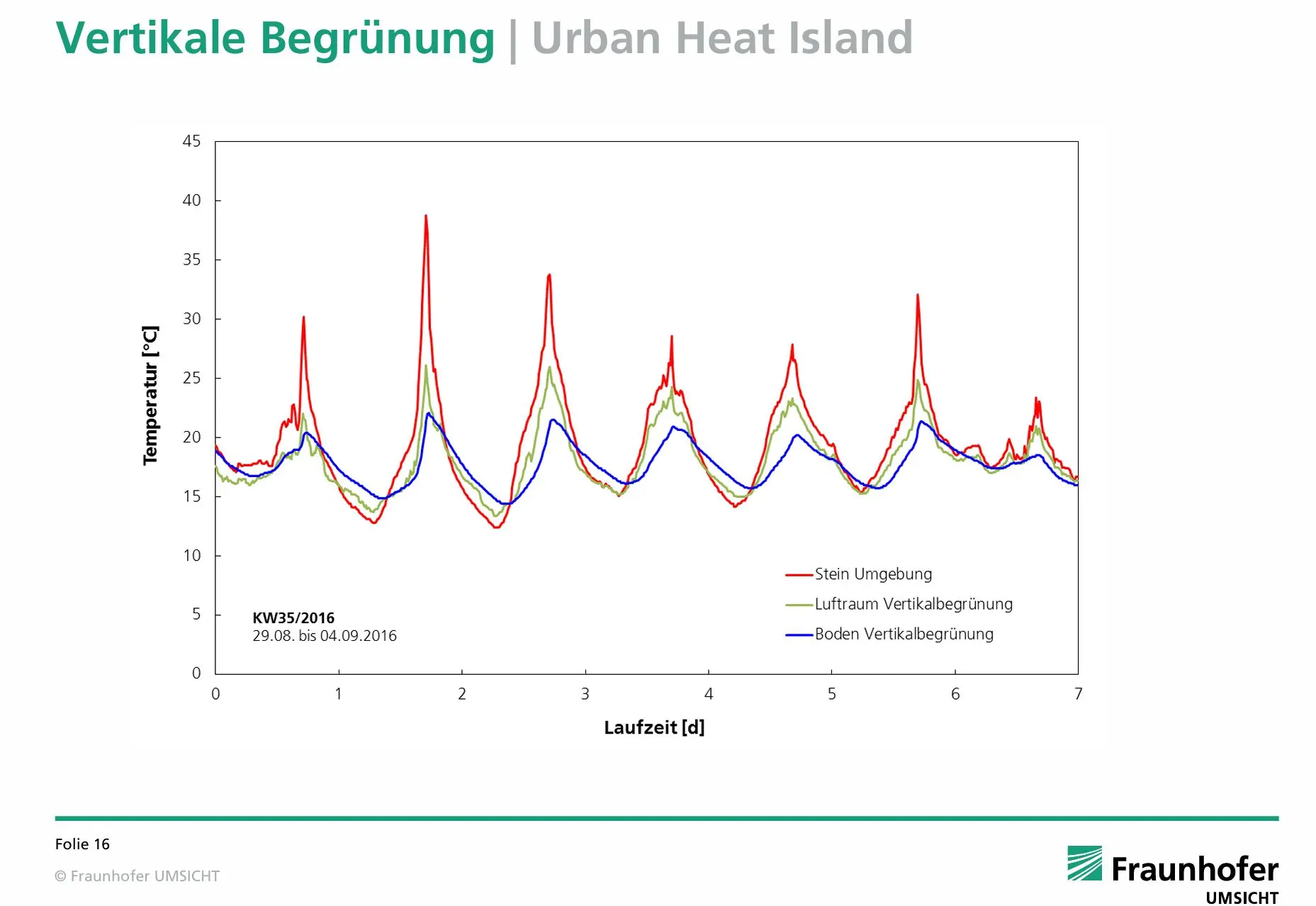
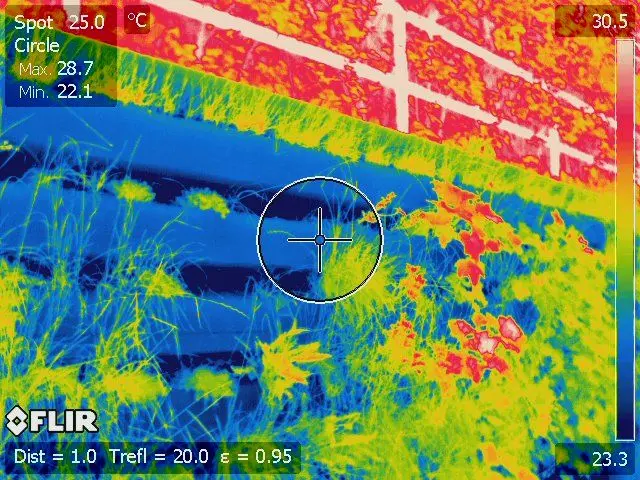
Vertical greenery shades the previously bare surface. The plants also release water through their leaves. The extent to which this affects the immediate surroundings depends on factors including plant coverage, water availability, orientation, wind, and distance from the wall. Measurements from a single wall should therefore not be applied to an entire garden without qualification.
6. Use rainwater where it is needed
Evaporation and healthy plant growth require a reliable water supply. Sensible measures include collected rainwater, soil cover, and irrigation directly in the root zone. Drip irrigation can distribute water where it is needed and, if appropriate, can be combined with timers or moisture sensors.
Irrigation lines should remain accessible and easy to inspect. For new green walls, irrigation therefore needs to be part of the design from the outset. Spraying large areas is generally less targeted than supplying the areas that are actually planted.
7. Design one connected climate zone
A comfortable seating area often consists of several elements: A tree or pergola blocks direct sunlight, a planting bed replaces part of the sealed surface, and a planted wall screens a hot or unattractive boundary. Suitable light-colored surfaces may also absorb less solar energy than very dark materials.
Include air movement and sightlines in the plan. A new wall should not unintentionally block an important airflow. At the same time, a well-positioned green screen can create a sheltered place to spend time. Which effect is more important must be assessed for the individual property.
When is Biolit Vertical Green a good fit?
Biolit Vertical Green is a modular, mineral-based system for planted walls. The planting blocks contain areas for substrate and irrigation. Depending on the project, they can be designed as a freestanding screen or as a planted outer-wall solution, among other applications. Fraunhofer UMSICHT describes the jointly developed system for both larger applications and smaller wall coverings and partitions.
Biolit is a particularly good fit when
- a bare wall or a wall receiving strong sunlight is to be planted,
- there is little ground space for a wide hedge or a large planting bed,
- a new green boundary wall or privacy screen is being planned,
- different plant species are desired within a defined grid,
- irrigation, construction, and the planting concept can be planned together from the outset.
Biolit is less likely to be the right fit when
- there is enough space for a shade tree and the only goal is to shade the seating area,
- a simple trellis on the existing wall already meets the objective,
- no suitable substructure or structurally sound construction can be provided,
- a reliable water supply is not possible,
- a completely maintenance-free solution is expected.
Real applications show different scales: The article about BUGA Mannheim documents a planted seating area, while the Hauptschule Wildeshausen uses a large wall. The existing guide Vertical greening systems: types, benefits, and comparison provides an overview of further system types. If the plan also includes visual and acoustic screening, see the article Planted noise barrier in the garden.
How to get started with your garden
- Mark hot surfaces, hours of sunlight, and the most important places where people spend time.
- First consider shade, trees, removing unnecessary paving, and the available soil area.
- For a wall, record its length, height, orientation, substrate, and water connection.
- Compare climbing plants, planters, and a systematic planted-wall solution.
- For structural solutions, have the foundation, structural design, irrigation, and plant selection assessed for the specific project.
Technical information is available in the downloads section. For an initial assessment, you can describe the site through our contact form or book a system presentation directly.
Frequently asked questions about a cooler garden
What cools a garden most quickly?
Direct shade at the seating area works most quickly. A shade sail or pergola works immediately. Trees combine shade with evaporation over the long term, but need time and sufficient root space.
Can a green wall substantially cool the entire garden?
A green wall can shade its surface and influence the microclimate in its immediate surroundings. Its effect on the entire garden, however, depends on size, plant coverage, water, wind, distance, and other green areas. Surface measurements are not the same as a general reduction in air temperature.
Which has a greater effect: a tree or vertical greening?
Where sufficient soil and canopy space are available, a tree is generally the first choice for broad shade. Vertical greening complements it where ground space is limited or an existing wall itself becomes a hot surface.
How can a garden be planted while using water efficiently?
Choose plants suited to the site and soil, cover bare ground, collect rainwater, and irrigate directly in the root zone. An accessible drip-irrigation system can make the supply easier to manage.
Can every existing garden wall be planted?
Not automatically. With climbing plants, the surface, trellis, and distance from the wall need to be considered. With a front-mounted solution or planting-block system, the foundation, structural design, connections, and water routing also need to be checked.
Which plants are suitable for vertical greening?
That depends on sun, shade, wind, frost exposure, substrate, and irrigation. Suitable choices are plants selected for the site with root-space requirements that match the system. A planting plan should therefore always be tailored to the specific wall.
Sources and further information
- Verbraucherzentrale: More comfortable temperatures without electricity – cooling the house with greenery, updated June 15, 2026.
- German Environment Agency: Heat in city centers – more trees and shade are needed.
- German Environment Agency: Rainwater evaporation – potential for cooling in cities and surrounding areas.
- Fraunhofer UMSICHT: Biolit Vertical Green at the Würzburg State Garden Show.
- Neue Landschaft: Soil-independent vertical greening based on planting blocks.